Family Register (Koseki Tohon) Translation Service | Handled by Licensed Administrative Scriveners and Includes a Certificate of Translation


Reliable and Prompt Translation of Family Registers
A clear guide to English translations of family registers required for visa applications and international procedures, including formatting conventions and key points regarding certificates of translation
Updated May 22, 2026
For overseas employment procedures, marriage procedures, including registering a marriage overseas or filing a notification of marriage in Japan, study abroad, and applications for a Spouse or Partner Visa, applicants are commonly required to submit a Certificate of All Records (Koseki Tohon) or a Certificate of Individual Records (Koseki Shohon). Many authorities also require these documents to be submitted in a form that can be read in English so that the reviewing officer can verify their contents. An English translation of the family register is therefore necessary.
When translating a family register into English, it is not enough merely to convert the Japanese text into English. The information recorded in the family register and the relationships among the persons listed must be translated in a way that can be clearly understood by a third party without misunderstanding. Depending on the receiving authority, such as an embassy, immigration authority, government agency, university, or employer, formal requirements may be clearly specified. These may include whether self-translation is permitted, whether the translator's signature is required, and whether a Certificate of Translation must be attached. Even an accurate translation may be rejected if it does not satisfy the applicable requirements, resulting in a request for resubmission. It is therefore important to confirm the requirements in advance.
In this article, licensed administrative scriveners explain how to confirm submission requirements, how to prepare an English translation through consistent formatting, readability, and the proper attachment of certification documents, and how to request a professional translation.
Contents
- Main Situations in Which a Family Register Translation Is Required
- Key Points in Family Register Translation: Relationships, Terminology, and Differences Between Legal Systems
- Whether Self-Translation Is Permitted and Cases in Which a Translation May Be Rejected
- When a Certificate of Translation Is Required
- Checklist Before Requesting a Translation: Number of Copies, Validity Period, and Romanization of Names
- Summary
1. Main Situations in Which a Family Register Translation Is Required
An English translation of a family register is primarily required in procedures where family relationships or personal status must be demonstrated through official documents. Typical examples include the following.
1) Submission for an International Marriage Procedure
When registering a marriage overseas, the administrative authority or diplomatic mission of the other country may require evidence concerning matters such as the person's unmarried status, birth information, parent-child relationships, or history of names. In Japan, these matters are collectively recorded in the family register. For this reason, a family register is often designated as one of the required documents, and its contents must be presented in a form that can be reviewed in English.
Many countries do not have a family register system. The receiving authority may therefore be unfamiliar with the structure and format of a Japanese family register. It is important to use consistent terminology and formatting in the English translation so that a third party can easily follow and understand the information.
2) Spouse or Partner Visa Applications
In a Spouse or Partner Visa application, the reviewing authority generally focuses on the following two points:
- Whether the marriage has been legally established
- Whether the applicant's identity and the relationship between the parties are consistent and free from discrepancies
Because a family register includes information concerning marriage, it is often used as evidence of the marital relationship. Depending on the procedures of the receiving authority, however, applicants may also be required to submit an additional document equivalent to a Marriage Certificate. An English translation of the family register often serves as a core application document. It is therefore important to prepare it in accordance with the receiving authority's requirements and in a format that allows the information to be easily cross-checked.
3) Procedures Relating to Children: Birth, Nationality, Dependents, Accompanying Family Members, and Study Abroad
International marriage procedures are often followed by a series of procedures involving children, such as birth registration, acquisition of nationality, verification of dependent relationships, and applications for visas for accompanying family members. Because a family register contains consolidated information concerning personal status, including parent-child relationships, English translations are frequently required for these procedures. Consistent formatting and readability are particularly important where proof of a parent-child relationship is a prerequisite for the review. Family register documents are also commonly required for study-abroad procedures.
4) Permanent Residence, Family Reunification, and Long-Term Stay Applications
In reviews relating to permanent residence or family reunification, proof of family relationships tends to be examined particularly carefully. Presenting an English translation of the family register in a way that allows a third party to understand at a glance who is related to whom and in what manner may reduce the risk of requests for additional evidence, such as a Request for Evidence, or RFE.
2. Key Points in Family Register Translation: Relationships, Terminology, and Differences Between Legal Systems
When translating a family register, it is necessary not only to produce an accurate English translation but also to consider that the structure of a Japanese family register does not correspond directly to the certificate systems used in other countries. In practice, there are three particularly important points.
1) Relationships: Correctly Interpreting and Presenting Relationships Between Individuals
A family register translation requires an accurate understanding of which person serves as the reference point, who is recorded as that person's spouse or child, and to which person each event, such as marriage, divorce, or acknowledgment of parentage, relates. Many receiving authorities have no prior knowledge of the Japanese family register system. When selecting terms such as "spouse," "child," "father," and "mother," the translation must clearly and accurately indicate whose information is being presented.
2) Terminology and Entries Unique to Family Registers: Accurate Correspondence Rather Than Mechanical Substitution
Unlike ordinary documents submitted overseas, such as birth certificates and marriage certificates, Japanese family registers contain descriptions of filing procedures and terminology specific to the family register system. Mechanically replacing these expressions with English words may produce grammatically correct English while making the document difficult for the receiving authority to understand or cross-check. Terms connected to the legal system should therefore not be loosely paraphrased. The translation should preserve the meaning of the original text, the definitions under the Family Register Act, and the relationships among the entries, while ensuring that all necessary information can be accurately understood.
3) Differences Between Legal Systems: Preparing the Translation for Countries and Authorities Without a Family Register System
In many countries, family relationships are established through separate certificates issued for individual events, such as a Birth Certificate, Marriage Certificate, or Divorce Certificate. A Japanese family register can demonstrate multiple matters in a single official record. From the perspective of a foreign receiving authority, however, it may appear to be an unfamiliar public record containing consolidated information. The structure and formatting of the translation should therefore be consistent so that the purpose and contents of the document can be understood without misunderstanding and easily cross-checked against other documents.
Sample English Translation of a Family Register | Nanairo Certificate Translation
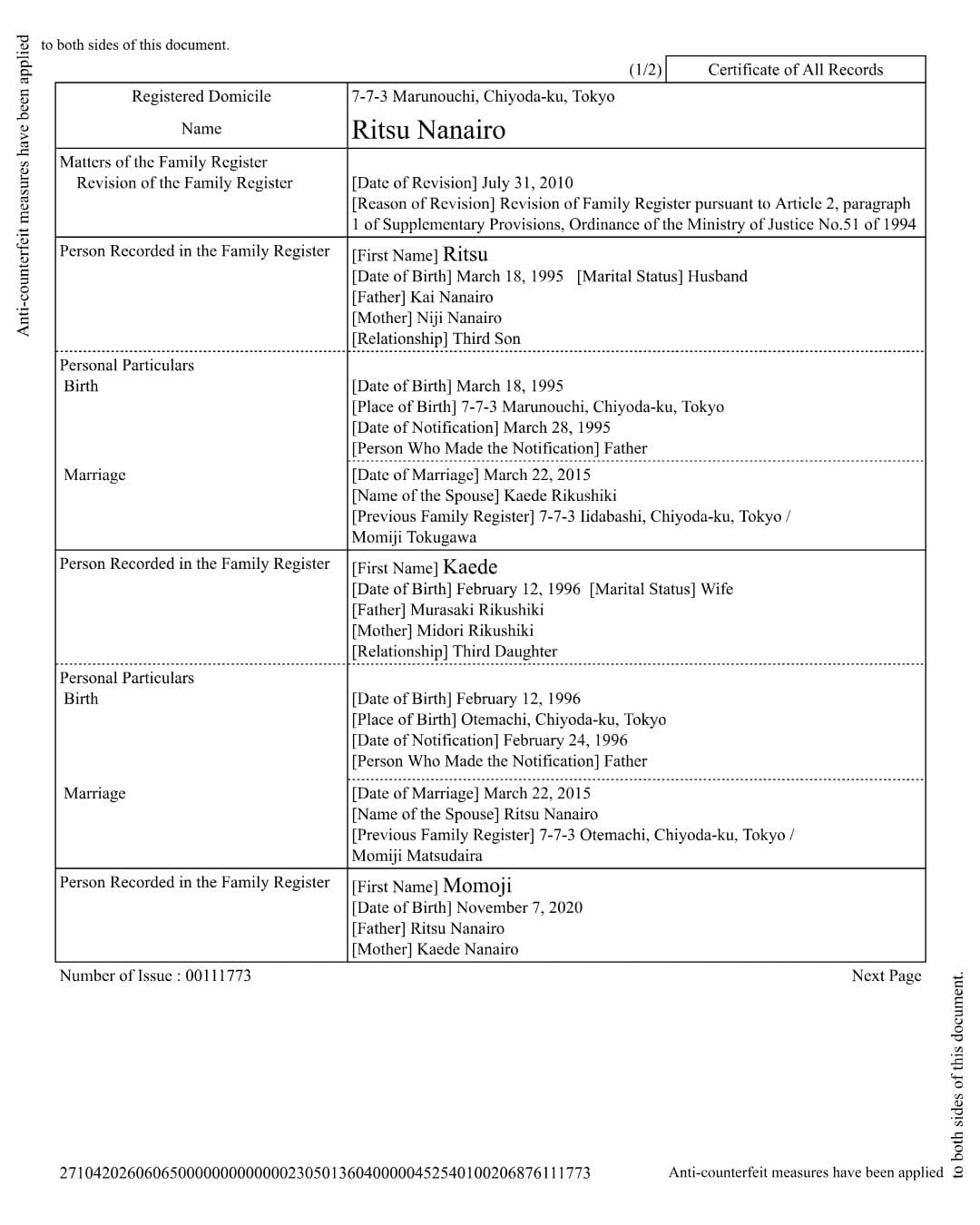
*This image is a sample and is not an English translation of an actual family register.
*This image shows the first page of a two-page family register. When the translation is delivered, the certification statement of the head of the municipality, the official seal, and all other information appearing on the final page will also be accurately translated.
3. Whether Self-Translation Is Permitted and Cases in Which a Translation May Be Rejected
Whether self-translation by the applicant is permitted cannot be determined by applying a single general rule in Japan. It depends on the rules, instructions, and practices of the receiving authority. Because a family register is often treated as an important document in the review process, a self-translation may be rejected, or the applicant may be asked to resubmit it, even when the translation itself is accurate.
Common Examples of Translations That May Not Be Accepted
- A self-translation is submitted even though the requirements specify a "certified translation" or a "translation by a professional" or "third party".
- The translator's signature and contact information are required, but no translator information is included with the translation.
- A Certificate of Translation is required, but none is attached.
- The correspondence between the original document and the translation is unclear, preventing the reviewing authority from matching individual items or pages.
- The Romanized spelling of a name does not match the spelling in the passport, requiring additional verification of the person's identity.
When a deadline is approaching, having to redo a translation may affect the entire application schedule. Where the receiving authority's requirements are unclear or the procedure is particularly important, such as a Spouse Visa application, preparing the translation from the outset in a submission-ready format, including the translator's signature and a Certificate of Translation, may ultimately reduce the risk of delays and rework.
4. When a Certificate of Translation Is Required
A Certificate of Translation is a document in which the translator declares that the translation is accurate and complete and identifies the person responsible for the translation by means of a signature. For English translations of family registers, a Certificate of Translation may be required particularly in the following situations.
1) The Submission Requirements Expressly State "Certified Translation"
For procedures relating to Spouse Visas or international marriages, the submission requirements may expressly state that a "Certified Translation" is required. In such cases, the receiving authority is concerned not only with the accuracy of the translation but also with whether the person responsible for the translation can be identified. Attaching a Certificate of Translation that clearly states the responsible party through a signature, date, and contact information is therefore an important practical consideration.
2) The Family Register Directly Relates to an Important Matter Under Review, Such as Marriage or a Parent-Child Relationship
A family register is frequently used to establish matters such as a marital relationship or parent-child relationship and is therefore treated as a document directly connected to an important part of the review. Formal requirements are consequently often imposed in addition to requirements concerning the accuracy of the contents. Attaching a Certificate of Translation may reduce the likelihood of formal deficiencies being identified and the documents being returned for resubmission.
3) The Receiving Authority's Requirements Are Unclear
In practice, the written requirements do not always clearly state whether self-translation is permitted or whether a certificate must be attached. In such cases, attaching a Certificate of Translation and clearly identifying the translator may make it easier for the receiving authority to review and verify the documents. However, where the submission requirements expressly require a third-party translation, notarization, or another form of certification, a self-translation will not be accepted, and a translation by an independent third party is essential.
Information That Should Be Included in a Certificate of Translation
- The translator's name in Roman letters
- The translator's address, telephone number, email address, or other contact information
- A declaration stating that the document has been faithfully translated from the original
- The date
- The translator's signature
*If any of these elements is missing, the Certificate of Translation may be regarded as having insufficient evidentiary value and may be returned for correction or resubmission.
For translations of Certificates of All Records and Certificates of Individual Records, it is important not only that the translation itself be accurate but also that the complete submission format, including the Certificate of Translation, satisfies the applicable requirements. Preparing the translation and certificate together as a complete submission package helps reduce the risk of rejection due to formal deficiencies.
5. Checklist Before Requesting a Translation: Number of Copies, Validity Period, and Romanization of Names
The following checklist is intended for those who need to arrange a translation of a Certificate of All Records or Certificate of Individual Records promptly. Confirming these points in advance helps minimize delays and repeated correspondence from the initial verification of requirements through delivery. Careful confirmation is particularly important for urgent cases.
1) Required Scope of Family Register Documents: Current Family Register, Removed Family Register, or Original Family Register Prior to Revision
Where the receiving authority requires a history from birth to the present or a record including marriage and divorce, the current family register alone may not satisfy the requirements. When the required scope is unclear, it may be necessary to contact the receiving authority for clarification.
2) Number of Copies and Intended Use: Whether There Are Multiple Receiving Authorities
Particularly where documents must be submitted to multiple authorities, confirming in advance whether a PDF is sufficient or whether paper documents are required will make it easier to determine the appropriate preparation and delivery format.
- Online application by uploading a PDF
- Submission at an embassy, consulate, or government office
- Bringing the documents to an interview
- Anticipated requests for additional submission in the destination country
3) Validity Period: Whether the Document Must Have Been Issued Within a Specified Number of Months
The receiving authority may require the Certificate of All Records or Certificate of Individual Records to have been issued within the previous three months, six months, or another specified period. Where the validity period is strict, it may be necessary to obtain a newly issued family register document before beginning the translation process. The date of issue should therefore always be checked.
4) Romanized Spelling of Names: Following the Passport Spelling
When translating names recorded in a family register into English, it is important to follow the spelling used in the passport. Using consistent spelling throughout all submitted documents, including the passport, can reduce additional inquiries concerning whether the documents relate to the same person.
5) Providing the Receiving Authority's Requirements: Self-Translation, Certification, and Submission Format
The most effective way to reduce rework is to provide the relevant portion of the receiving authority's requirements.
- Whether self-translation is permitted
- Whether the translator's signature and contact information are required
- Whether a Certificate of Translation is required
- Whether submission by PDF is sufficient or whether the original or a paper copy must be presented
Once these matters have been confirmed, the required deliverables, including the translation, certificate, and formatting, can be clearly determined, reducing unnecessary back-and-forth communication.
6) Quality of Images and PDFs: All Pages and, Where Applicable, the Reverse Side
A family register photographed with a smartphone can be used for translation. However, if the text is difficult to read, additional questions and verification may be required, which may increase the amount of work involved. A scanned PDF is preferable whenever possible. At a minimum, all pages must be included, and every entry must be clearly legible. If remarks or additional entries appear on a separate page or on the reverse side, those parts should also be provided so that the entire document can be faithfully translated in the form in which it will be submitted.
6. Summary
When translating a Certificate of All Records or Certificate of Individual Records into English, it is important to accurately translate and organize the information recorded under Japan's Family Register Act and family register system in a form that the receiving authority can read, understand, and evaluate. The following three points are particularly important for preventing rejection or requests for resubmission:
- Confirming the submission requirements (including whether self-translation is permitted, whether a signature is required, whether a Certificate of Translation is required, and whether submission by PDF is permitted)
- Using consistent formatting (Romanized names that match the passport, date formats, and address formats)
- Preparing a faithful and easy-to-understand translation in which relationships and other important information can be readily identified
For procedures where the review process or deadline has significant consequences, such as international marriage procedures, Spouse Visa applications, permanent residence, immigration, or study abroad, preparing the documents in a format that satisfies the submission requirements and attaching a Certificate of Translation where necessary will generally result in a smoother process with less risk of rework.
Nanairo Certificate Translation is operated by two licensed administrative scriveners with extensive practical translation experience. We review not only the accuracy of the translation but also the formal requirements for overseas submission. We also provide notarization and apostille services, including assistance with the relevant application procedures.
Written by

Approximately 8 years of experience at a consulting firm.
Drawing on expertise in requirements and issue structuring from upstream processes in management, operations improvement, and IT, I provide precise and attentive translation and support.