U.S. Birth Certificate Translation into Japanese | Administrative Scrivener Service with a Certificate of Translation

Japanese Translation of U.S. Birth Certificates | Administrative Scrivener Service
Licensed Administrative Scriveners accurately translate U.S.-issued birth certificates into Japanese and explain whether a Certificate of Translation or apostille is required.
Created on September 4, 2026
For procedures such as filing a notification of birth or marriage in Japan, applying for a status of residence, or completing nationality-related procedures, you may be required to submit a Japanese translation of a Birth Certificate issued in the United States.
U.S. birth certificates have various names and formats depending on the state or county, including Certificate of Live Birth and Certificate of Birth. Because the information shown is not uniform, it is important for the translation to accurately reproduce the structure of the original so that the receiving authority can easily compare the two documents.
In this article, licensed Administrative Scriveners explain the procedures for which a translation may be required, the different types of birth certificates, whether a Certificate of Translation or apostille is needed, and the applicable fees and turnaround times.
Contents
- When a Japanese Translation of a U.S. Birth Certificate May Be Required
- U.S. Birth Certificate Formats Vary by State, County, and Other Issuing Authority
- Types of Birth Certificates to Check Before Requesting a Translation
- Information That Must Be Accurately Reflected in the Japanese Translation
- Sacramento, California Birth Certificate | Sample Japanese Translation
- Can You Translate It Yourself?
- Differences Between a Certificate of Translation, Notarization, and an Apostille
- Services Provided by Nanairo Certificate Translation
- Fees and Turnaround Time
- How to Request a Translation
- Frequently Asked Questions
- Summary
1. When a Japanese Translation of a U.S. Birth Certificate May Be Required
1-1. Filing a Notification of Birth in Japan for a Child Born in the United States
If either parent is a Japanese national and the child is born in the United States, a notification of birth is filed with a Japanese embassy or consulate or with a municipal office in Japan. A birth certificate issued by the relevant U.S. state, county, or other authority, together with a Japanese translation, may be required.
If a Japanese national is born abroad and also acquires a foreign nationality at birth, a declaration to reserve Japanese nationality generally must be made within three months of the date of birth in order to retain Japanese nationality. Required documents and acceptable certificates vary by receiving authority, so check its instructions in advance.
For example, the Consulate General of Japan in Los Angeles lists a county-issued birth certificate and its translation among the required documents. It also states that an Abstract Birth Certificate cannot be used because the abbreviated version does not contain all required information.
1-2. International Marriages, Notifications of Marriage, and Other Family Register Procedures
When a foreign national files a notification of marriage in Japan or completes a similar procedure, a birth certificate and Japanese translation may be requested to confirm the person's name, date of birth, place of birth, parents' names, and other information. The spelling of the name may also be checked for consistency with the passport, marriage certificate, and other documents.
1-3. Status-of-Residence and Family-Relationship Procedures
When applying for a Certificate of Eligibility in Japan or applying to change or extend a status of residence, a foreign birth certificate may be submitted as evidence of a parent-child relationship. The Immigration Services Agency of Japan also lists a birth certificate as one type of document that can establish the applicant's relationship to the supporting family member in its guidance on the "Dependent" status of residence.
If the birth certificate is in English, a Japanese translation must be attached. Additional supporting documents may be requested depending on the type of application, and a birth certificate alone may not be sufficient to establish the family relationship.
Birth certificates are also used in procedures involving acquisition of Japanese nationality, inheritance, schools, and other matters to confirm the fact of birth or a parent-child relationship. The Ministry of Justice's guidance on acquisition of nationality also states that Japanese translations must be attached to documents written in a foreign language. In practice, however, any requirements imposed by the receiving authority concerning the format of the translation or the translator take precedence.
2. U.S. Birth Certificate Formats Vary by State, County, and Other Issuing Authority
The United States does not have a single, nationally standardized birth certificate. Birth records are maintained by the Vital Records Office, Registrar, or other authority of the state, county, city, or other jurisdiction where the birth occurred. The U.S. Centers for Disease Control and Prevention (CDC) also instructs applicants to identify the state or territory where the birth occurred and apply to the appropriate local office. Contact information can be found in "Where to Write for Vital Records."
Examples of document titles include:
- Birth Certificate
- Certificate of Live Birth
- Certificate of Birth
- Certification of Vital Record
- Certified Copy of Birth Record
Do not determine whether a document is valid solely from its title. Check the issuing authority, the registrar's signature, the certification seal, the registration number, and other features to confirm that it is an official birth record.
3. Types of Birth Certificates to Check Before Requesting a Translation
3-1. Long Form and Short Form (Abstract)
In general, a Long Form contains detailed birth information, while a Short Form or Abstract is an abbreviated version. However, document names and the information included vary by state. A Short Form may not be sufficient for a procedure that requires the parents' names, detailed place-of-birth information, the registration date, or similar information. Confirm which version is acceptable before requesting a translation.
3-2. Certified Copy
A Certified Copy is a copy issued and certified as official by the authority responsible for the record. It is distinct from an ordinary photocopy or a commemorative certificate issued by a hospital that may include the newborn's footprints. If an official certificate is required, confirm the issuing authority before requesting a translation.
3-3. Consular Report of Birth Abroad (CRBA)
A U.S. embassy or consulate may issue a Consular Report of Birth Abroad, or CRBA (Form FS-240), to a person who was born outside the United States and acquired U.S. citizenship from a parent at birth. The U.S. Department of State describes a CRBA as a document recording the person's U.S. citizenship at birth. Because it differs from a state- or county-issued Birth Certificate in nature and certifying authority, confirm which document the receiving authority requires.
4. Information That Must Be Accurately Reflected in the Japanese Translation
When translating a U.S. birth certificate into Japanese, the entire original document must be reviewed and accurately translated, including not only the main text but also marginal notes, certification statements, seals, amendments, and other entries. The main items include:
- The person's name, middle name, and sex
- Date and time of birth, place of birth, and hospital name
- Parents' names, mother's maiden name, and parents' places of birth
- Information about the informant, physician, and other persons
- Date of filing, date of acceptance, and date of issuance
- Certificate number and registration number
- The registrar's title and certification statement, signatures, seals, and amendments
Cross-Check Names Against the Other Documents Being Submitted
Names written in the Latin alphabet should generally remain in English exactly as shown on the original and should be rendered in Japanese when necessary. If a katakana rendering is required, confirm the applicant's preferred spelling or the spelling already in use in Japan. Omitting a middle name or reversing the family name and given name can affect cross-checking against other documents, so the translation should remain faithful to the original.
Do Not Confuse the Functions of Different Dates
Date of Birth, Date Filed, Date Accepted, and Date Issued should be clearly distinguished and translated into Japanese as "出生日," "登録日," "受理日," and "発行日," respectively. The same principle applies when translating other certificates.
Reproduce the Structure of the Original as Faithfully as Possible
The order of items, tables, and grouping of fields should follow the original as closely as possible so that the receiving authority can easily identify where each entry in the original appears in the translation.
5. Sacramento, California Birth Certificate | Sample Japanese Translation
The following is an example of a Sacramento, California birth certificate that Nanairo Certificate Translation has translated. All personal information has been replaced with fictitious details so that no real person can be identified.
Anonymized sample Japanese translation of a Sacramento, California birth certificate
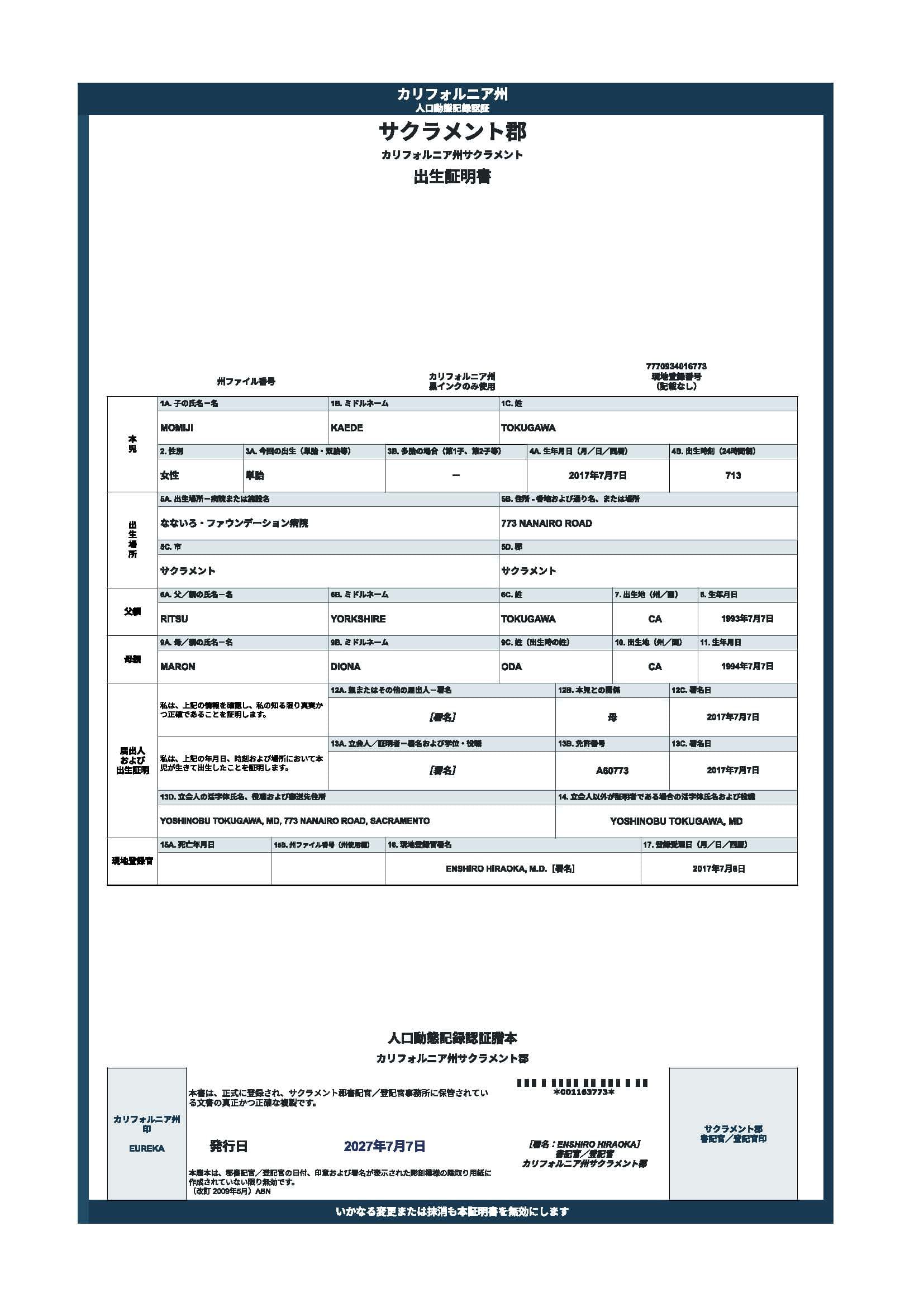
This image is an anonymized sample Japanese translation of an actual Sacramento, California birth certificate, with fictitious personal information. Formats and entries vary depending on the year of issuance and the issuing county.
The sample translates the person's name, date and time of birth, place of birth, parents' information, registration date, certificate number, registrar's certification statement, and other entries into Japanese while preserving the order and placement of the original fields as closely as possible. This makes it easier to compare the original and translation and identify the corresponding entries.
Points to Check When Submitting a California Birth Certificate
California birth certificates are available as a Certified Authorized Copy, which may be used to establish identity, and a Certified Informational Copy, which may not be used to establish identity. The latter bears a statement that it is not a valid document for establishing identity. Both are copies certified by a public authority, but an Informational Copy may be insufficient for certain submission purposes. Confirm the type of certificate and the receiving authority's requirements before requesting a translation.
In addition, when obtaining an apostille for a California-issued birth certificate, prior authentication may be required depending on the title or capacity of the public official who signed the certificate. Before proceeding, it is important to check the receiving authority's instructions, including whether the certificate should be translated after the apostille has been obtained and whether the apostille itself must also be translated into Japanese.
References: California Department of Public Health, "Authorized Copy vs. Informational Copy"; California Secretary of State, "Apostille Frequently Asked Questions"
6. Can You Translate It Yourself?
Whether a self-prepared translation is accepted depends on the receiving authority and the procedure. Some Japanese diplomatic missions publish a prescribed translation form with a field for the translator's name, and not every procedure requires a translation by a qualified professional.
However, using an independent translator offers significant benefits in situations such as the following:
- The document is a Long Form with many entries
- An independent third-party translation is expressly required
- Names and other information must be strictly consistent with other documents
- The translator's signature or a Certificate of Translation is required
Even when a self-prepared translation is permitted, it must be prepared carefully to avoid omissions or confusion among dates. If a prescribed format is provided, use it. If the format is unrestricted, reproduce the original document's format as faithfully as possible.
7. Differences Between a Certificate of Translation, Notarization, and an Apostille
These three procedures serve different purposes.
| Procedure | Primary role |
|---|---|
| Certificate of Translation | The translator certifies that the translation is faithful to the source document. |
| Notarization | A notary public certifies a signature, oath, or similar act on a Certificate of Translation or related document. |
| Apostille | Authentication under the Hague Apostille Convention of the signature, seal, or similar feature on a public document. |
Attaching a Certificate of Translation does not mean that the birth certificate itself has received an apostille. Conversely, an apostille does not certify the accuracy of the Japanese translation.
An apostille is not always required. Birth certificates issued by a state or county are handled by the competent authority of the issuing state, while federal documents such as a CRBA involve a different authority. Before obtaining authentication, confirm whether the receiving authority requires a Certified Copy, an apostille, a notarized translation, or some combination of these.
8. Services Provided by Nanairo Certificate Translation
Nanairo Certificate Translation provides Japanese translations of Birth Certificates, Certificates of Live Birth, Certified Copies of Birth Records, CRBAs, and other birth-related documents.
8-1. Translation and Double-Checking by Licensed Administrative Scriveners
Two licensed Administrative Scriveners review the person's name, date of birth, parent-child relationships, issuing authority, certification statements, and other information and prepare a Japanese translation that is faithful to the source document.
8-2. A Format That Is Easy to Compare with the Original
We reproduce the original layout, order of items, and tables as closely as possible so that the correspondence between the original and the translation is easy to understand.
8-3. Issuance of a Certificate of Translation
When required, we issue a Certificate of Translation under the name of a licensed Administrative Scrivener. It identifies the document translated, states that the translation is faithful to the source, and includes the translator's information, date of preparation, signature or seal, and other relevant details.
8-4. The Entire Process Can Be Completed Online
If you have a clear PDF or image, you generally do not need to mail the original. The entire process, from quotation to delivery, can be completed online. Printed copies can also be mailed.
9. Fees and Turnaround Time
The standard fees for one U.S. birth certificate are as follows.
| Service | Fee (excluding tax) |
|---|---|
| Japanese translation of one U.S. birth certificate | JPY 6,000 |
| Issuance of a Certificate of Translation | JPY 3,000 |
We normally deliver the PDF within two business days after confirming the details of the request and receipt of payment. Printing and domestic mailing are available for JPY 2,000, excluding tax. If the translation is urgent, we will let you know whether expedited service is available.
10. How to Request a Translation
- Send a clear PDF or photograph showing the entire birth certificate. Although they are often unnecessary, please also include the reverse side, apostille, and any attached pages where applicable.
- Tell us the intended use, receiving authority, deadline, and your preferred katakana rendering of the name.
- After providing the fee and turnaround time, we will begin the translation once payment has been confirmed.
- Two licensed Administrative Scriveners will check the names, dates, place names, registration numbers, and other information.
- We will deliver the Japanese translation and, if requested, a Certificate of Translation.
11. Frequently Asked Questions
Q1. Can I submit an image taken with a smartphone?
Yes. We can work from a smartphone image as long as the text, seals, and all four corners of the document are clearly visible.
Q2. Do I need to mail the original document?
Usually not. We can translate from a PDF or image, but please confirm with the receiving authority whether the original must be presented when you submit your documents.
Q3. Can you also translate a Certificate of Live Birth?
Yes. We translate birth-related documents whose names and formats vary by state and county.
Q4. Can I request a translation of a Short Form or Abstract?
Yes, we can translate it. However, if a Long Form or another specific version is required, a shortened version may not be accepted.
Q5. Is a Certificate of Translation always required?
Not necessarily. Some procedures accept a prescribed form or a translation prepared by the applicant, while others require the translator's signature, qualifications, or an independent third-party translation.
Q6. Is an apostille always required?
No. This depends on the receiving authority. Many procedures do not require one, so confirm the requirements before obtaining an apostille.
12. Summary
When using a U.S. birth certificate in Japan, it is important not only to prepare an accurate translation but also to confirm the type and format of document required by the receiving authority.
- U.S. birth certificates vary in name and format by state, county, and other issuing authority
- The information included may differ between a Long Form and a Short Form
- Names, place of birth, parents' names, registration date, date of issuance, and other entries must be translated accurately and distinguished clearly
- A Certificate of Translation, notarization, and an apostille each serve a different purpose
- Follow the receiving authority's instructions concerning the required documents and translator qualifications
Nanairo Certificate Translation provides Japanese translations of U.S. birth certificates that are reviewed by two licensed Administrative Scriveners and delivered in a format that is easy to compare with the original. If you need a Japanese translation for a notification of birth or marriage in Japan, an immigration or status-of-residence application, a nationality-related procedure, or another purpose, please contact us with a PDF or photograph of the birth certificate and details of the receiving authority and intended use.
Written by

After corporate experience at a bank and investment bank, now working as an administrative scrivener assisting with various document preparation.
Committed to both accuracy and speed, I provide careful translation and support.